Documentation version: v0.1.0 · Source revision
Cobalt

A modal terminal editor with a tile-based workspace.
Cobalt brings Vim-style editing, floating shells, code completion, language-server navigation, and Git into one keyboard-driven workspace. Written in OCaml, with a Bonsai_term frontend.
This is my personal editor, built around the way I work. Feel free to clone it and build from source; the direction and design decisions are mine.
Getting started · Keybindings · Configuration · Packaging · Local documentation · Online documentation
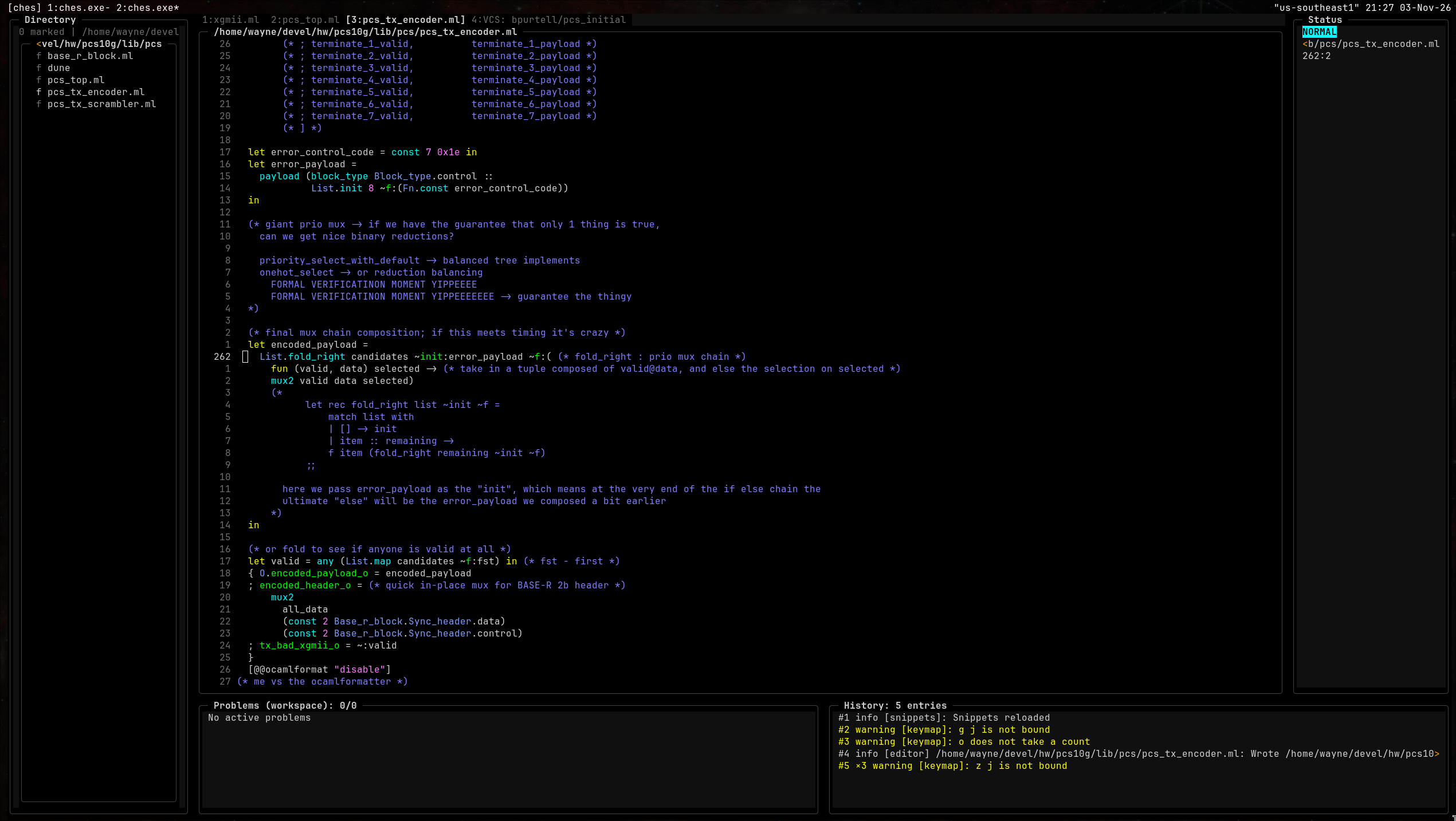
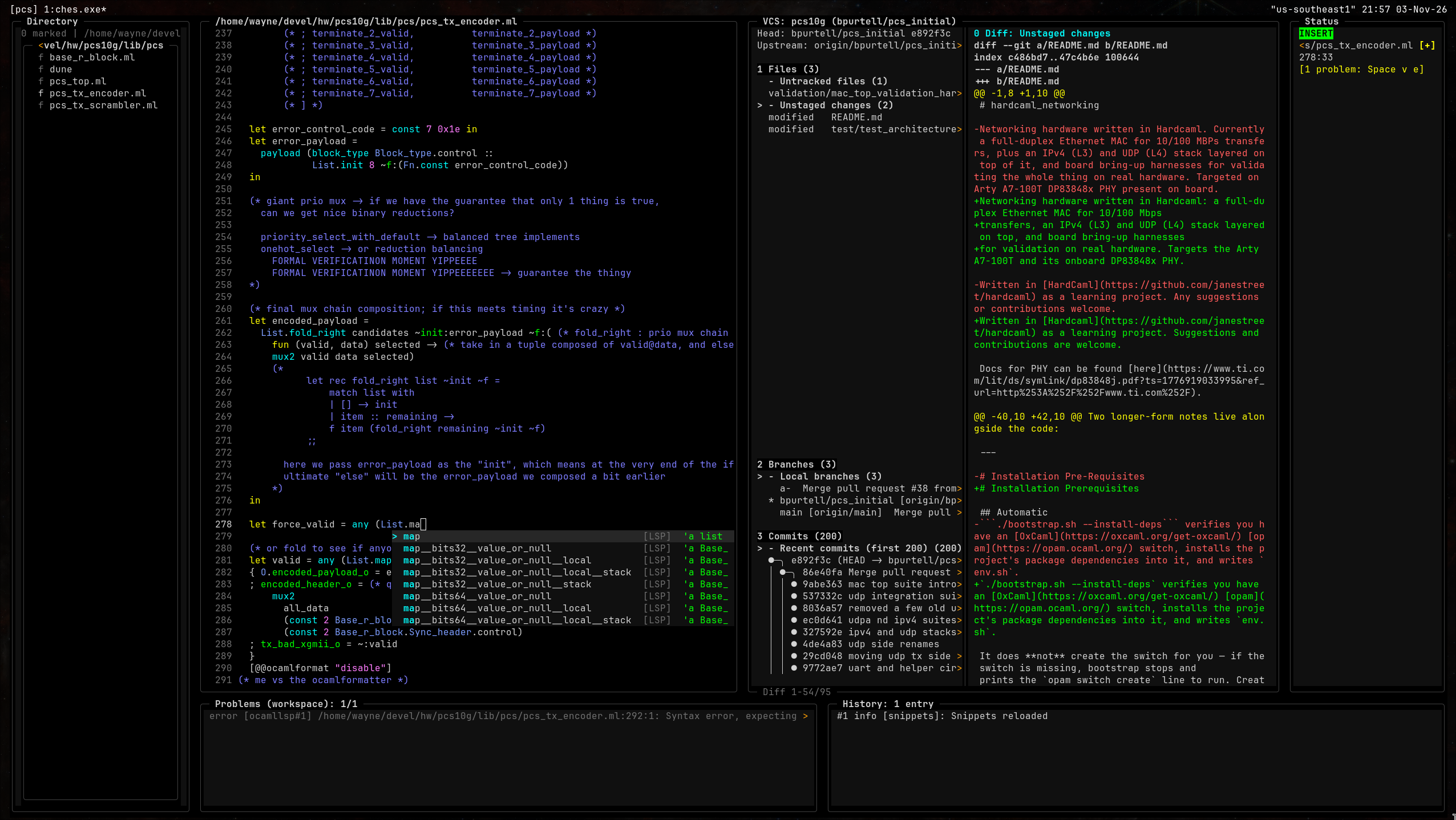
My everyday workspace: OCaml source in the middle, project files on the left, and status and diagnostics around the edges.
A workspace that stays out of your way
- Modal editing. Normal, Insert, and characterwise, linewise, and blockwise Visual modes, with counted motions, operators, search, indentation, and undo.
- Tiles when you need them. Start in Zen, open supporting views around your document, or switch to borderless Bare mode. Keep independent files in tabs.
- Find your place. Fuzzy file and current-document pickers, project content search, and editable directory listings for working across a project.
- Git without leaving the editor. A lazygit/Magit-inspired view for diffs, staging, commits, branches, history, and merge or rebase conflicts.
- Language-aware editing. Built-in highlighting for C++, Rust, Bluespec Classic and Bluespec SystemVerilog,
OCaml, Verilog, SystemVerilog, and GAS assembly. Attached language servers supply completion,
hover, definitions and references; OCaml also supports signature help and
interface/source switching. Inspect servers with
Space l i. - Reusable snippets. Searchable templates, linked fields, choices and filename variables, with custom snippets defined in your OCaml configuration.
- Make it yours. Executable
config.ml, live theme previews, semantic completion colors, adjustable layouts, and optional key hints. Runtime changes remain session-local unless you put them in your configuration. - Optional Markdown styling.
--markdownadds headings, emphasis, code surfaces and link/list styling without hiding source or changing save bytes. Choose Toggle document decorations in the palette; tables stay source-shaped.
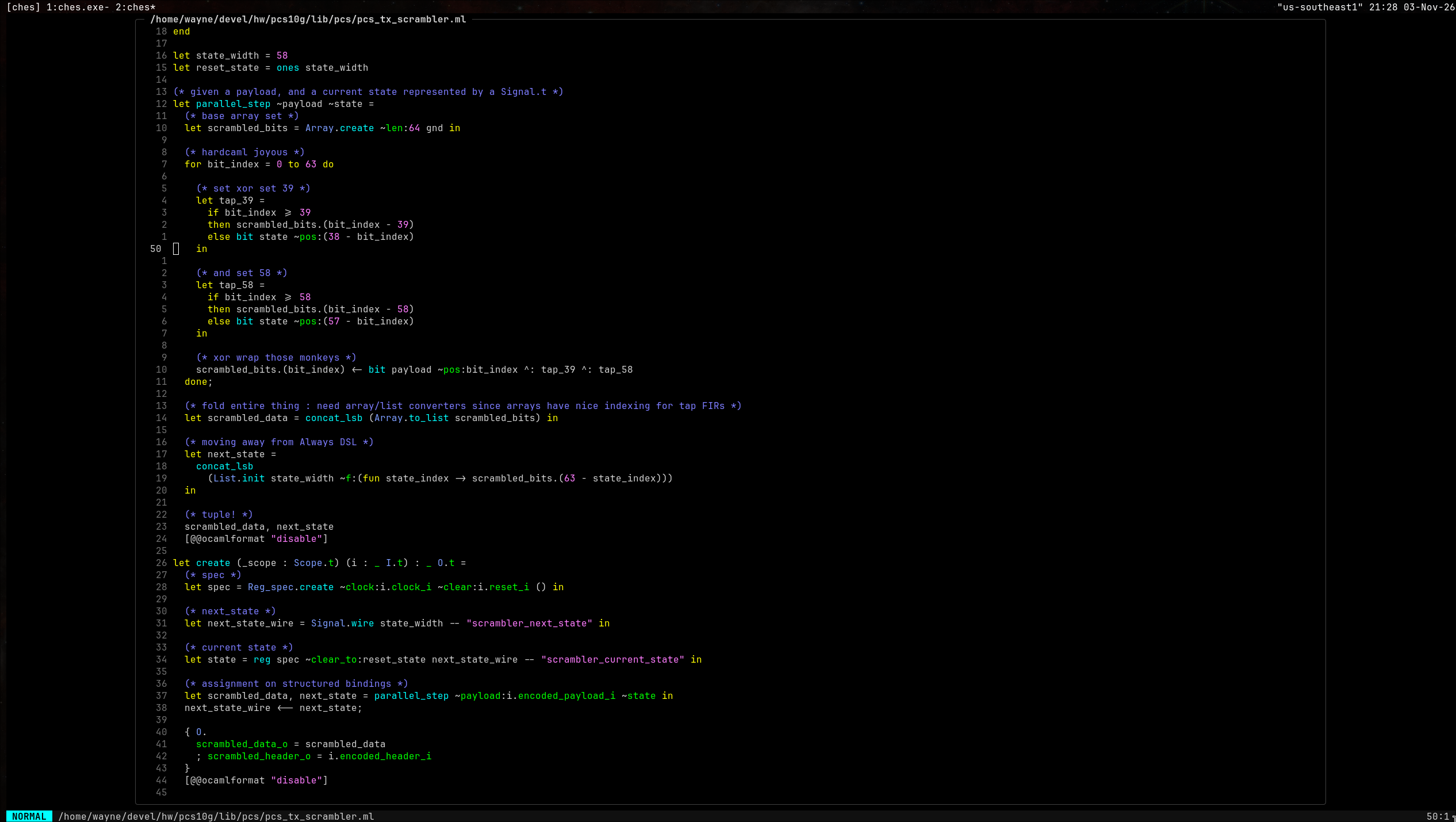
Focus when you want it, tiles when you need them
Space v z switches between the tile workspace above and focused Zen editing
below. Hide the supporting views without leaving your file, then bring them back
when you need the directory browser, problems, or notification history. For an
even smaller interface, Space v B toggles borderless Bare mode.
In the command palette (Space c c), Layout: Silver shows Silver: Overview,
Silver: Stage Checklist, and Silver: Flow Runner alongside the editor.
Type flow to focus Flow Runner without switching or running a flow.
Layout: Default returns to the ordinary workspace. History stays available
on demand (Space v M).
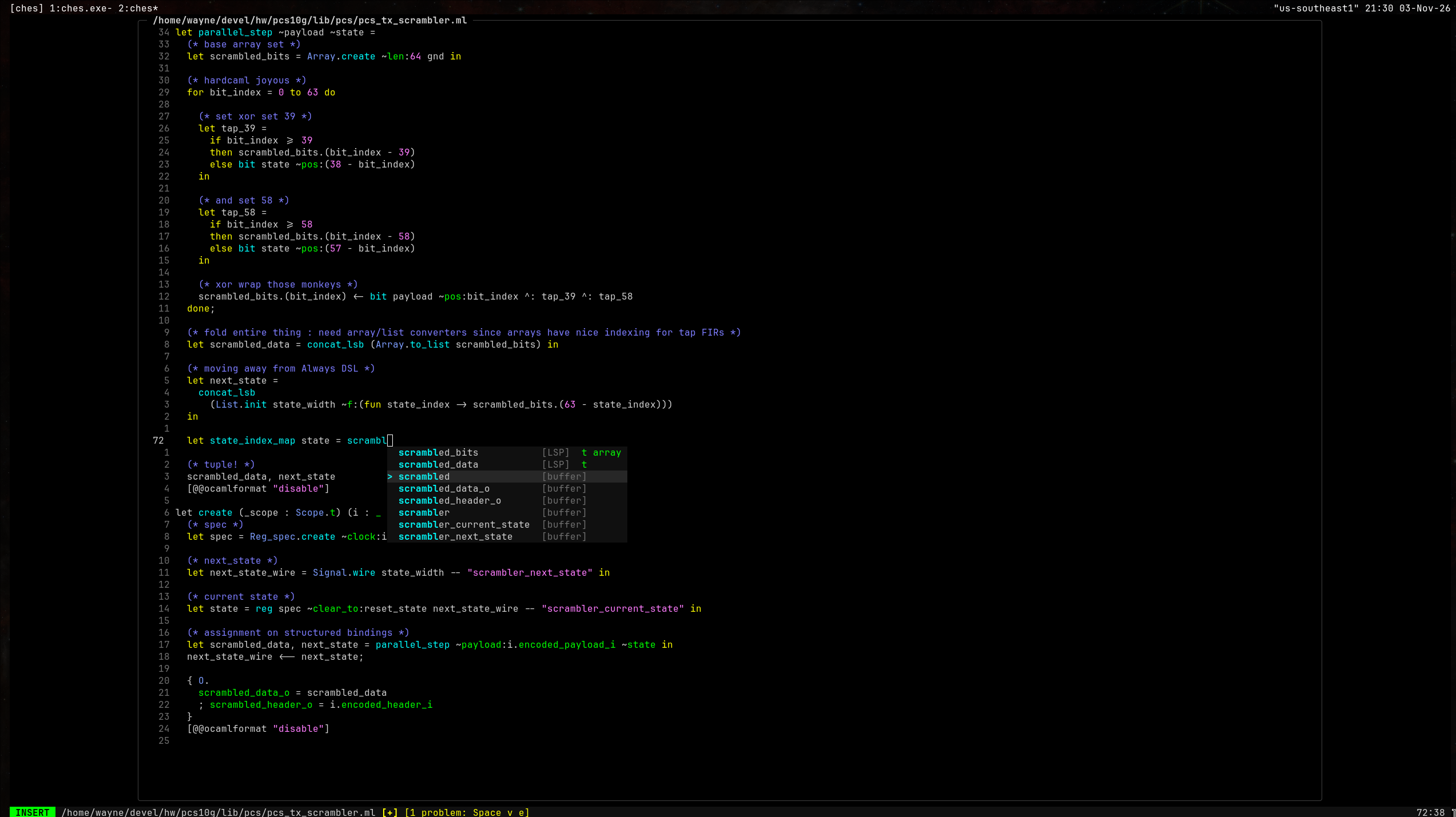
Completion in context
Language-server suggestions and words from the current buffer appear beside your cursor, with their sources labeled. LSP entries can also show type information, so you can choose a completion without leaving the code. Use Ctrl-n in Insert mode to request completion manually.
Tile Terms
An interactive shell, one toggle away. Space / opens or hides a Tile Term;
3 Space / selects terminal 3. Each numbered session keeps its shell, jobs,
screen, and preferred size while hidden.
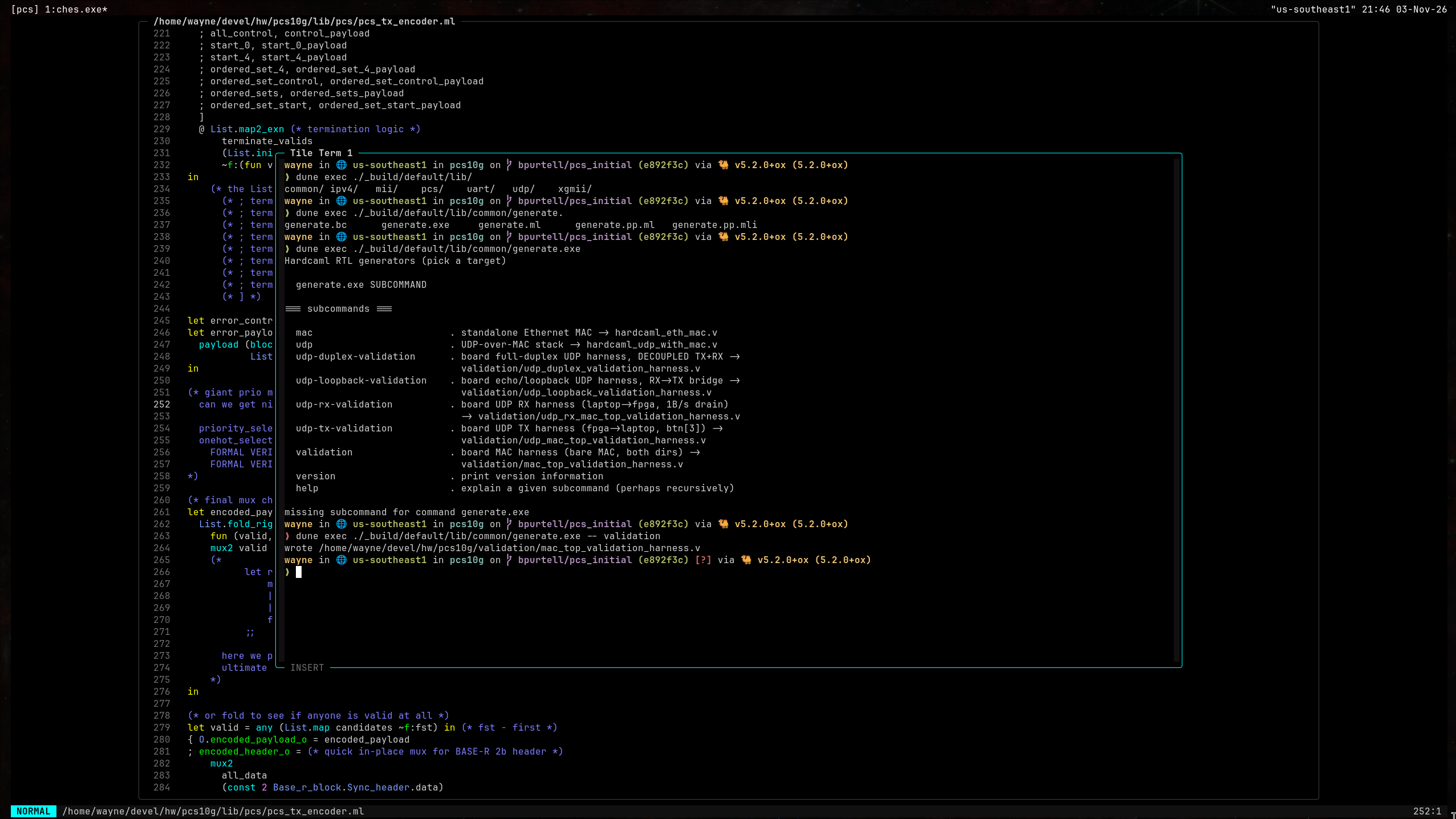
Toggle directly from Normal or Insert mode. Use rapid jk to enter terminal
Normal mode, then navigate, select, and yank text into the editor. i returns
to the shell; + / - resize the float.
See the Tile Terms guide for modes, numbered sessions, and Insert-mode shortcut timing.
Git beside your code
Space g g opens the Git view. Review diffs, stage files or individual hunks
and lines, write commits, and browse branches and history without switching to
another application. Keep the source visible alongside the change you're
reviewing.
Find code without losing your place
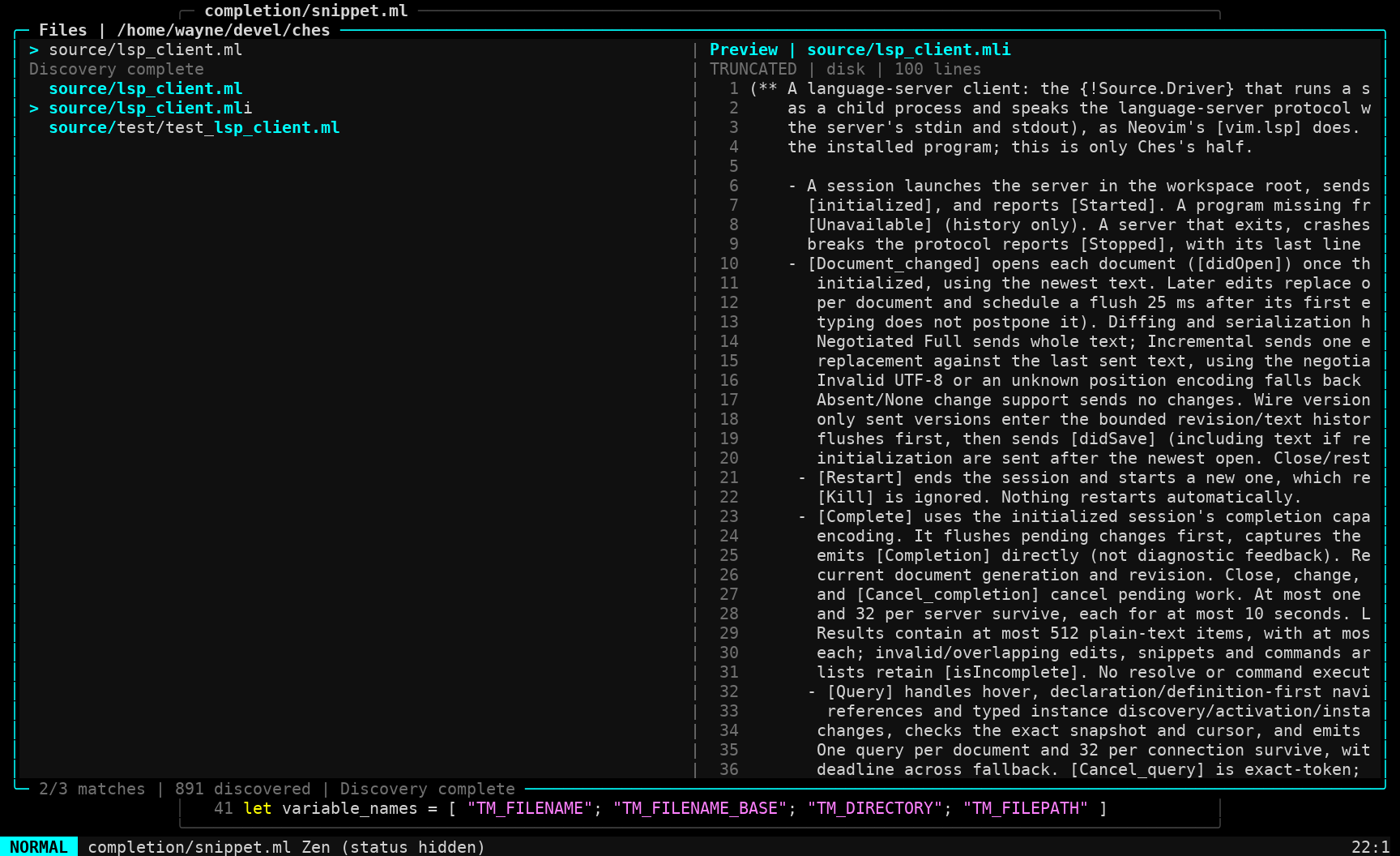
Project files and symbol references have source previews. Inspect the result first, jump when you're ready, and use Ctrl-o to return.
Project navigation — fuzzy file search with source preview
Find references — real ocamllsp results with a highlighted source preview
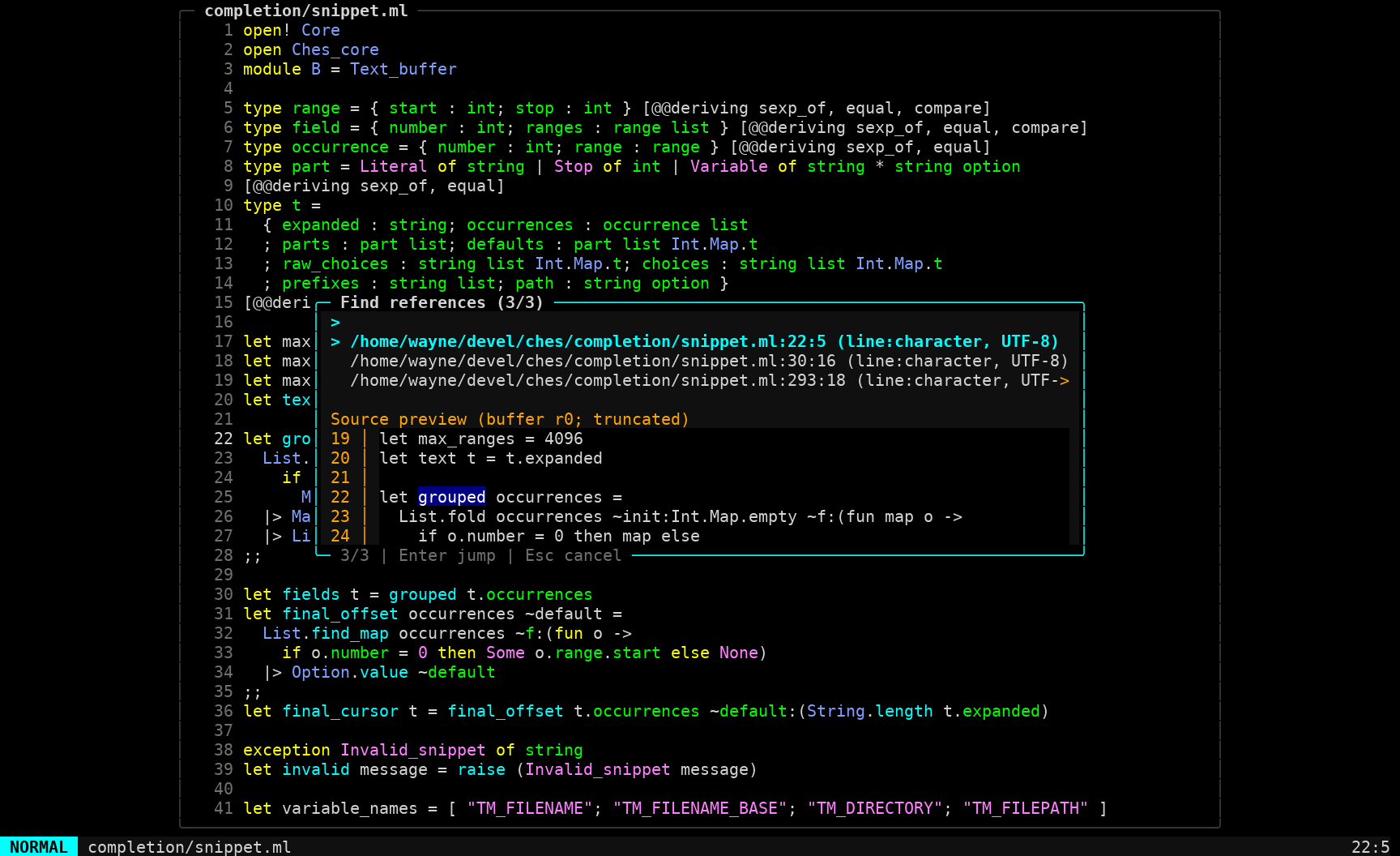The screenshots above show my own editing sessions. The two navigation examples use reproducible terminal-frame captures; see the image notes for their capture recipe and rendering limits.
Getting started
Install from a clone
With opam, a compatible OxCaml switch, and the build dependencies:
git clone https://github.com/bopurtell/cobalt.git
cd cobalt
./install.sh
export PATH="$HOME/.local/bin:$PATH"
cd /path/to/your/project
cobalt .
The installer copies cobalt, cobalt-open, and the public libraries to
$HOME/.local by default. No sudo or active opam shell is needed to run the
installed editor. To upgrade, update your clone and rerun ./install.sh with
the same prefix. See source installation for custom
prefixes and old co aliases, and uninstall
to remove just Cobalt from a shared prefix.
Open a directory to browse a project, or pass a file path to edit it:
cobalt completion/snippet.ml   # Vim Classic theme, Zen layout
cobalt --workspace .           # Full tile workspace
 cobalt --no-mouse .            # Start with terminal-native selection and copying
cobalt --bare core/editor.ml   # Borderless editing (also --superzen)
cobalt --theme glacier .       # Choose a different theme
cobalt --list-themes           # Browse available palettes
For blue palettes, try cobalt-room, cobalt-midnight (deep navy),
cobalt-electric (vivid accents), cobalt-mist (soft slate blue), or
cobalt-frost (light icy blue). Preview them in the theme picker with Space v T,
or launch with cobalt --theme cobalt-midnight ..
Mouse clicks and wheel scrolling are enabled by default. Use Toggle mouse
in the command palette (Space c c) to switch to terminal-native selection and
back without restarting. See Mouse input
for supported gestures.
Use --main-editor and cobalt-open to send a file
location to a specific running Cobalt session.
Linux packages
Cobalt can be packaged as an extract-and-run .tar.gz containing its executable,
notices, source snapshot, manifest and checksums. Basic editing does not require
an OCaml/opam installation: highlighting assets and terminal emulation are embedded.
The currently tested build targets Linux x86-64 with glibc 2.38 or newer
(built on Ubuntu 24.04). It is not a universal static binary. Git, ripgrep, language
servers, and ocamlc for evaluating config.ml are optional external tools for
their respective features.
From the development checkout, create a download package with:
python3 scripts/package_release.py --version snapshot --strip -j 6
Artifacts are written to dist/. See the release/installation guide
for extraction, verification, platform requirements, and the outstanding
source/license work before a public release. No hosted release is published by
this command.
A few keys to start
Space below means the spacebar. Unless noted, editor commands use Normal mode.
| Keys | Action |
|---|---|
h / j / k / l |
Move |
i / Escape |
Enter Insert / return to Normal |
u / Ctrl-r |
Undo / redo |
Space w / Space q |
Save / quit |
Space c c |
Open the command palette |
Space f f / Space f g / Space f l |
Find files / search contents / find lines |
Space o |
Show the file's parent in the main area / return to file |
Space b n / Space b p |
Next / previous file tab |
Space g g |
Open the Git view |
Space l i |
Inspect attached language servers and their status |
K / gd / gD / gr |
Hover / declaration / definition / references |
Ctrl-o / Ctrl-i |
Jump back / forward |
Ctrl-n (Insert) |
Request completion manually |
Space / / N Space / |
Toggle Tile Term / select numbered session; also works in Insert |
Space v z / Space v B |
Toggle Zen / Bare |
Space v T |
Choose a theme |
The editor reference covers the full keymap, directory
operations, and terminal controls. cobalt --help lists command-line options.
Documentation
- Editor reference — keys, modes, workspace, Git, and Tile Terms.
- Directory workspace — browsing and filesystem operations.
- Pickers — file navigation and project search.
- Development — toolchain, builds, and tests.
- Configuration — OCaml settings, snippets, and completion colors.
- Release packaging — downloadable archives, installation, and runtime requirements.
- Architecture — source layout and module boundaries.
- Project status — support, limitations, and validation notes.
For design notes, backlogs, and implementation history, see the documentation index.